Section 02 of 09
The pigment network
The pigment network is the single most important structure to understand in dermoscopy. It is the pattern you will see most often, and learning to read it confidently is the foundation of everything that follows.
What it looks like
Imagine a fishing net or honeycomb laid flat against the skin. Through the dermatoscope, you see a mesh of thin brown lines forming a grid, with lighter spaces in between. The lines are the rete ridges of the skin — ridges where melanin-producing cells sit — and the lighter holes are the tops of the dermal papillae.
What makes a network "typical"
A normal, healthy pigment network has several recognisable characteristics:
- Regular spacing — the holes in the mesh are roughly the same size throughout the lesion
- Uniform line thickness — the brown lines are similar in width across the network
- Symmetric fading — the network tends to thin out gradually and evenly towards the edges of the lesion, rather than stopping abruptly on one side
- Consistent colour — the brown tones are relatively even, without sudden dark patches or areas of very different hue
Think of it as a well-made piece of fabric. The weave is even, the threads are consistent, and the edges are neatly finished. You would immediately notice a snag, a hole, or a section where the thread suddenly changed colour.
A typical pigment network is regular, symmetric, and fades gradually at the edges. When you see these qualities, it is a reassuring sign. Later modules will show you what an atypical network looks like — but first, get comfortable with the normal version.
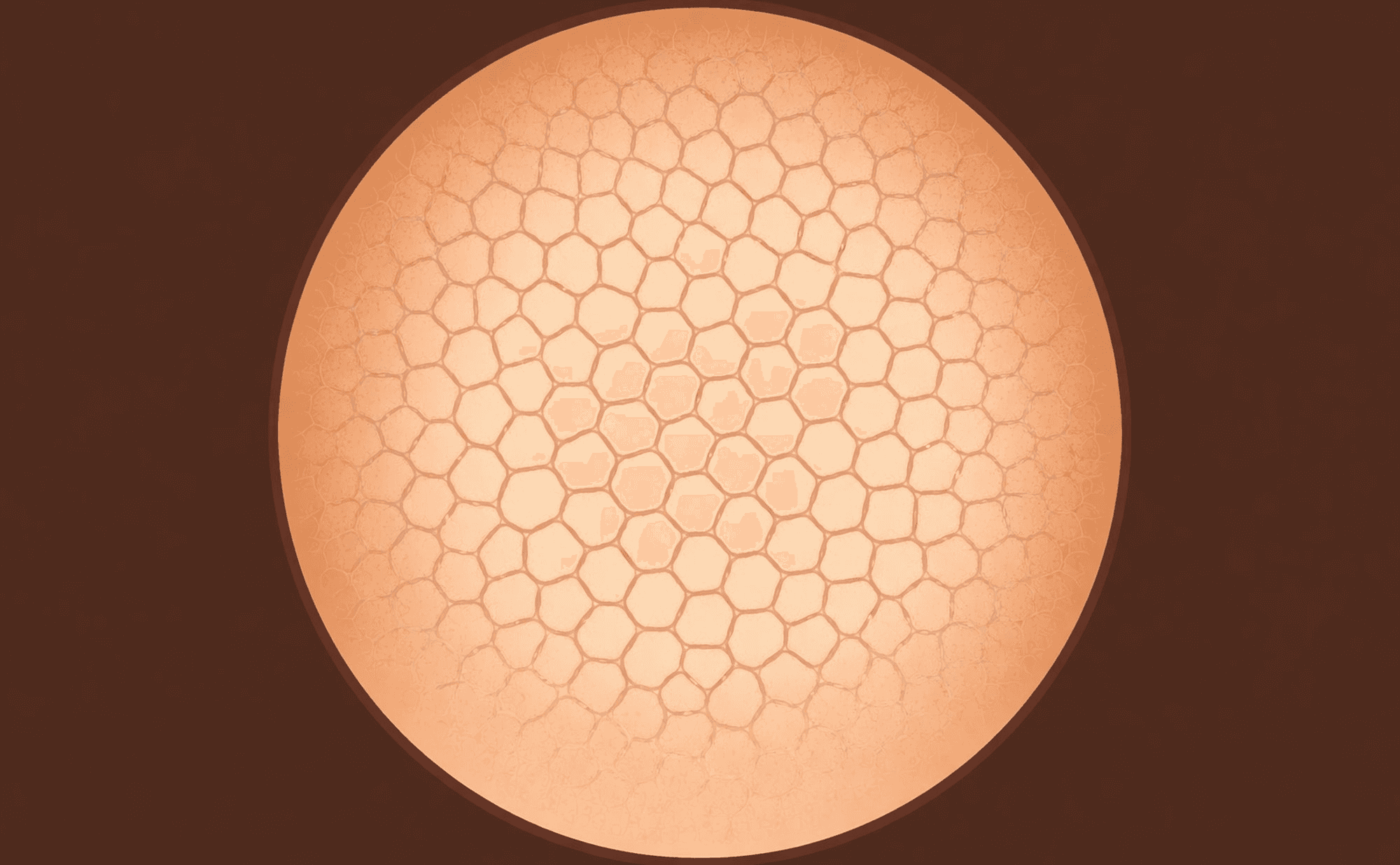
A typical pigment network — regular mesh spacing, uniform line thickness, and gradual peripheral fading.
Where you will see it
The pigment network is most easily seen in melanocytic lesions on the trunk and limbs. These are the classic sites where moles appear, and where the regular honeycomb pattern shows most clearly.
On other body sites — the face, palms, soles, and nails — the pigment network looks quite different. We will cover those site-specific variations later in this module.
A note on terminology
You may see the pigment network described as a reticular pattern in some textbooks. The terms are interchangeable — "reticular" simply means net-like.
Which of the following best describes a typical (normal) pigment network?