Section 05 of 12
When the pattern breaks: basal cell carcinoma
Basal cell carcinoma (BCC) has distinctive vascular and structural features. Unlike melanocytic lesions, BCC typically lacks a pigment network — which is itself a useful clue.
Arborising vessels
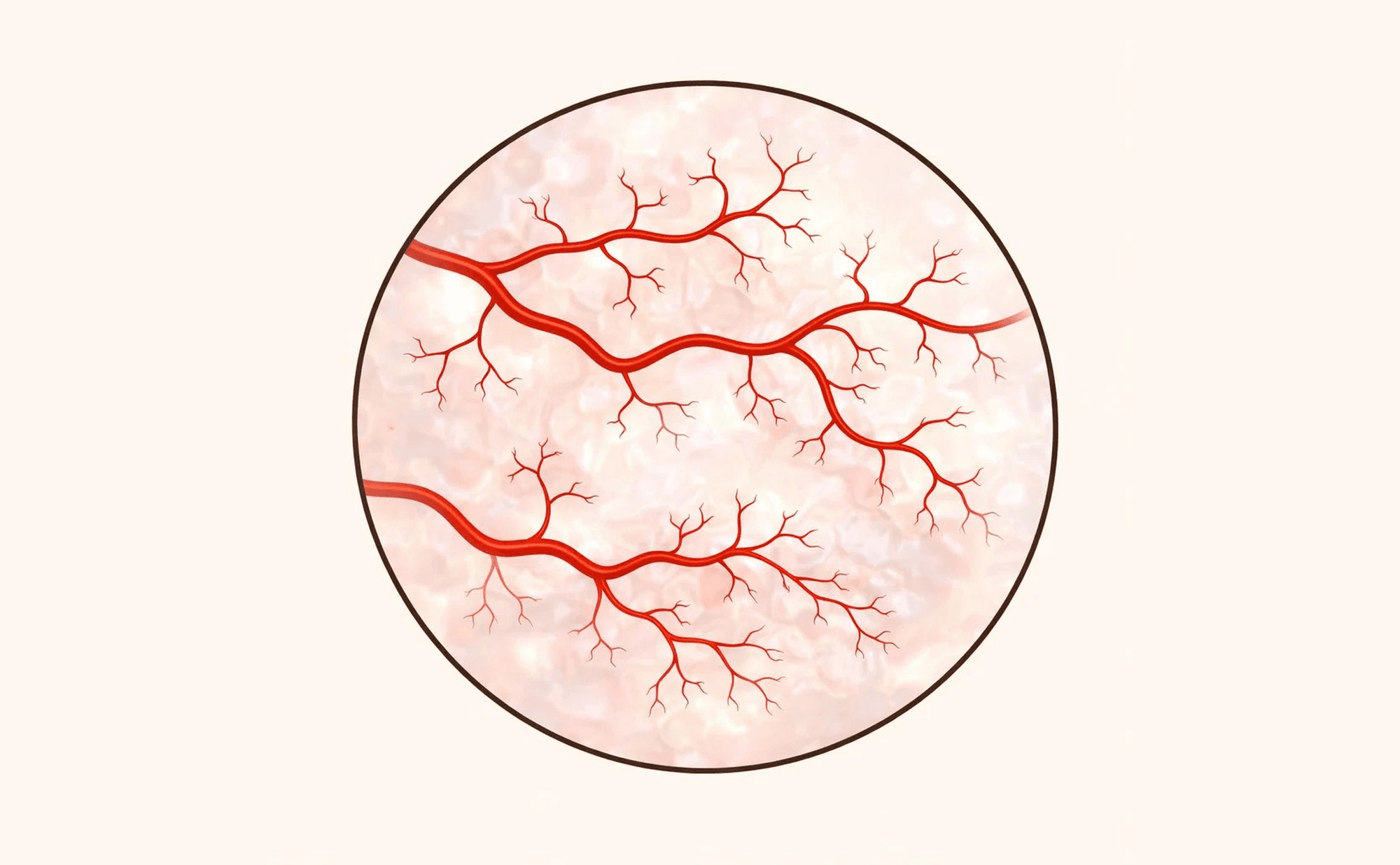
Arborising vessels — tortuous main vessels with progressive branching and calibre reduction on pearly BCC skin.
The classic BCC vessel pattern: bright red, branching vessels resembling tree branches — a thick trunk with progressively finer branches.
Shiny white structures
Bright white lines or areas visible only in polarised dermoscopy. These may appear as short white streaks (sometimes called "chrysalis" structures) and indicate stromal changes within the tumour.
Blue-grey ovoid nests
Well-circumscribed blue-grey structures representing pigmented tumour nests. Often multiple within the lesion. Their rounded, well-defined shape distinguishes them from the irregular blue-grey areas seen in melanoma.
Leaf-like areas and spoke-wheel structures
Brown to grey-blue structures resembling leaf edges — bulbous projections from a common base. Spoke-wheel structures are a variant: radial projections meeting at a darker central point. Both are features of pigmented BCC.
Ulceration
Loss of surface epithelium, appearing as a red structureless area or crust. Common in nodular BCC and a sign of locally advanced disease.
BCC features cluster around two themes: distinctive vessels (arborising, branching) and structural changes (shiny white structures, blue-grey nests). When you see these in a lesion that lacks pigment network, BCC should be high on your differential.