Section 04 of 10
Step 2 — Organisation assessment
The question
"Is this lesion organised or disorganised?"
The logic
If a lesion isn't clearly one of the three benign patterns, the next discriminating question is about its structural organisation. This step applies the perception skills from Module 1 and the normal/abnormal recognition from Modules 2 and 3.
The principle is straightforward: benign lesions tend to grow in an orderly way, producing symmetric, uniform structures. Malignant lesions tend to grow irregularly, producing asymmetric, chaotic structures.
What organised looks like
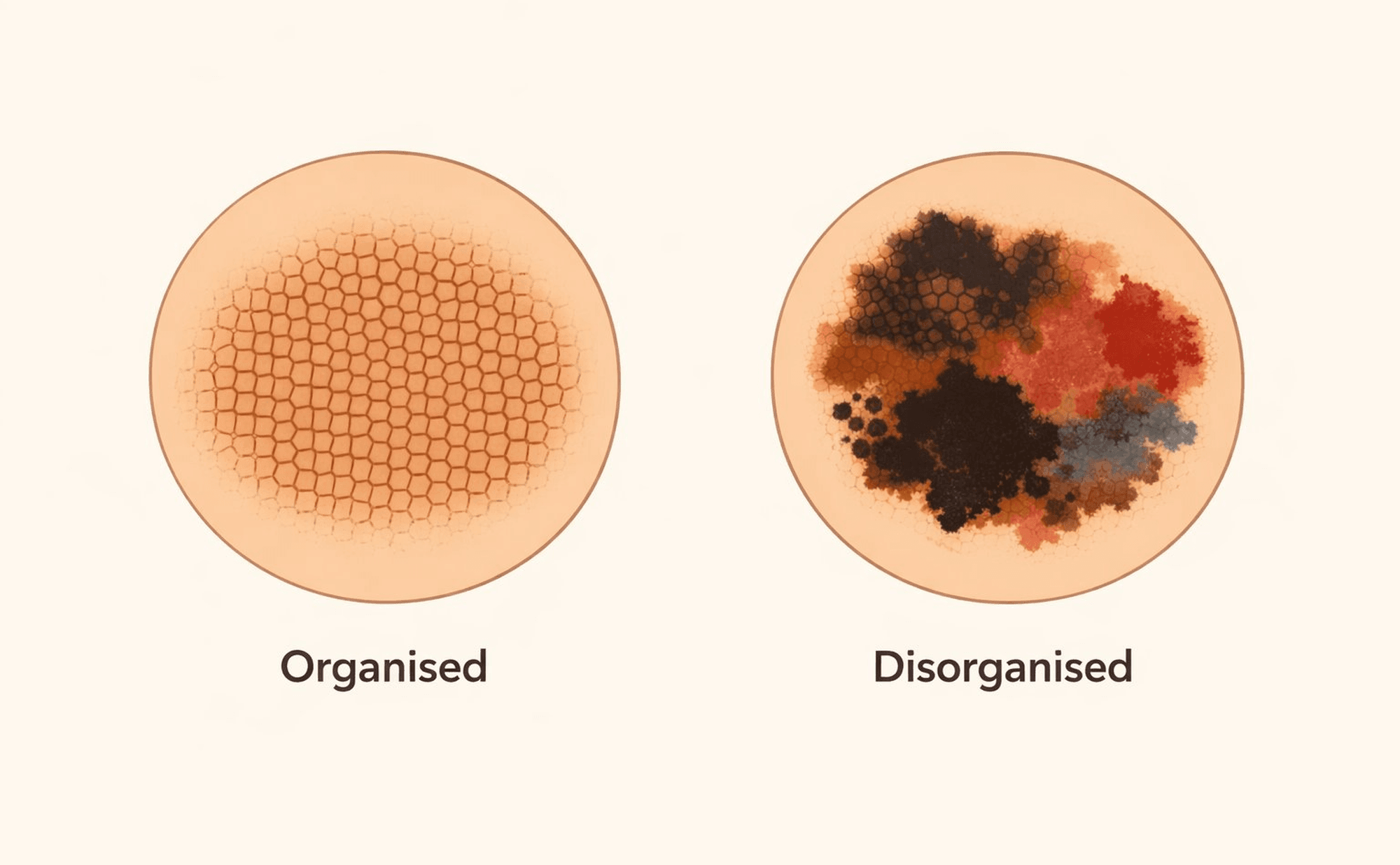
Organised (left) versus disorganised (right) — symmetric orderly structure compared with asymmetric chaotic structure.
An organised lesion has:
- Symmetric structure — similar appearance when you mentally compare the two halves
- Uniform pattern — consistent network, colours, or structures throughout
- Orderly distribution — features arranged regularly, not randomly scattered
- Gradual transitions — colours and structures fade gradually at the edges rather than stopping abruptly
A common example is a benign melanocytic naevus — it doesn't match any of the Step 1 trio, but it shows a regular pigment network, symmetric structure, and orderly colour distribution. It's organised.
What disorganised looks like
A disorganised lesion has:
- Asymmetric structure — different patterns when you compare halves
- Variable features — multiple patterns, colours, or structures without uniformity
- Chaotic distribution — features scattered randomly or clustered in focal areas
- Abrupt transitions — sharp changes in colour or pattern within the lesion
Disorganisation reflects the irregular, uncontrolled growth associated with malignancy.
The decision
If ORGANISED — the lesion shows symmetric, orderly structure. Consider routine monitoring with appropriate follow-up. Safety-netting advice ensures the patient knows to return if the lesion changes. Photographic documentation supports future comparison.
If DISORGANISED — the lesion shows asymmetry, chaos, or irregular structure. Proceed to Step 3.
When you're not sure
Organisation exists on a spectrum. Some lesions are clearly organised; some are clearly disorganised; many sit somewhere in between. What do you do when you genuinely can't decide?
When uncertain about organisation, treat as disorganised. The cost of proceeding to Step 3 unnecessarily is a few more seconds of analysis. The cost of dismissing a disorganised lesion as organised could be a missed malignancy. TADA is deliberately designed to err on the side of safety.
A pigmented lesion doesn't match any Step 1 benign pattern. It shows two shades of brown, a regular pigment network that fades at the edges, and symmetric structure when you compare the halves. How would you classify this lesion at Step 2?